How to scale a recipe up or down (without ruining it)
Cooking for twelve instead of four, or for one instead of six, is rarely a matter of multiplying every line. Bulk ingredients scale cleanly. Seasoning, leavening, evaporation and heat transfer do not — which is why a doubled cake sinks and a halved curry tastes flat. Here is what to change, and what to leave alone. In a hurry? Use the free recipe calculator to convert the quantities first.
By Your Recipe · Updated 21 August 2026
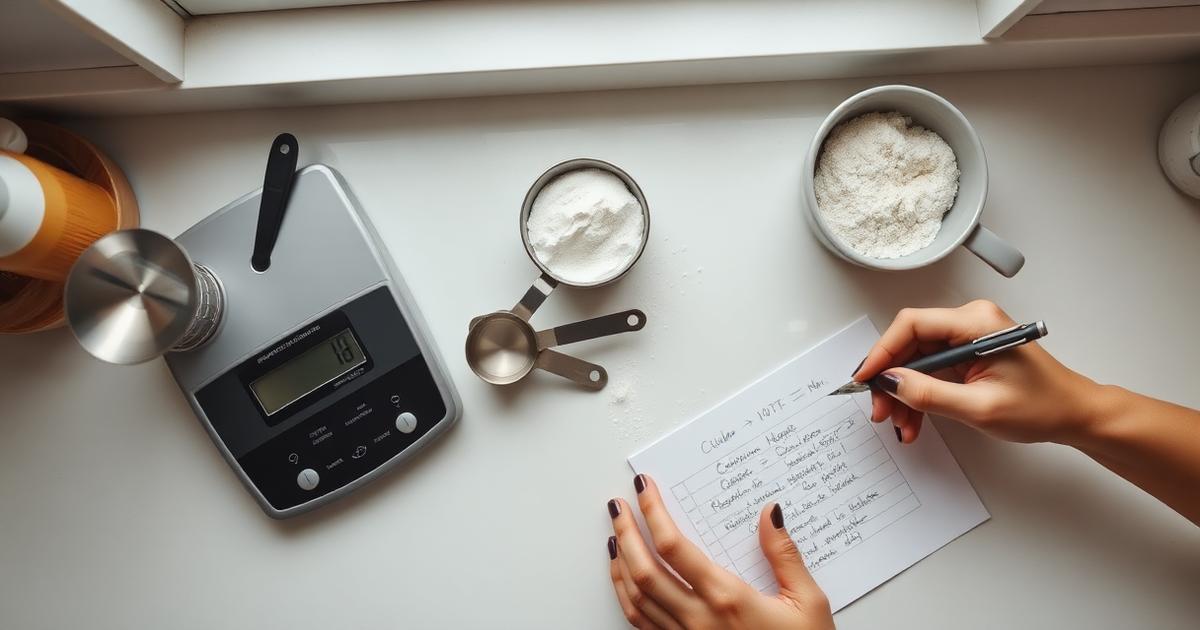
Start by converting to weight
Volume measurements compound their own error as you scale: three-quarters of a cup of flour packed differently three times over is a noticeably different dough. Convert to grams first, then multiply — the free recipe converter turns cups and spoons into grams for 20+ ingredients.
| Ingredient | Measure | Grams | Millilitres |
|---|---|---|---|
| Plain flour | 1 cup | 120 g | 240 ml |
| Granulated sugar | 1 cup | 200 g | 240 ml |
| Butter | 1 cup | 227 g | 240 ml |
| Water / milk | 1 cup | 240 g | 240 ml |
| Rice (raw) | 1 cup | 185 g | 240 ml |
| Rolled oats | 1 cup | 90 g | 240 ml |
| Fine salt | 1 tsp | 6 g | 5 ml |
| Egg (large, no shell) | 1 egg | 50 g | — |
Based on a 240 ml US cup. Weights vary a little by brand and by how tightly an ingredient is packed.
What does not scale linearly
Salt and spices
Scale by about 1.5× when doubling, 0.6× when halving. Taste before adding the rest — you can always season up.
Baking powder and soda
Over-leavened batter rises fast then collapses. Use around 1.5× for a doubled batch and check that the tin is no more than two-thirds full.
Yeast
Yeast multiplies on its own, so a doubled dough rarely needs double yeast. Keep it near 1.25× and judge by how the dough proves, not by the clock.
Alcohol, vanilla and extracts
These concentrate as they reduce. Scale to about 1.5× and add the last portion near the end.
Thickeners (cornflour, roux, gelatine)
A wider pan evaporates more, a taller pot less. Start at 1.5× and adjust once you see the consistency.
Fat for frying
Oil covers a surface, not a volume. Use enough to coat the pan you're actually using, regardless of the batch size.
Pan size and bake time
Baking follows depth, not volume. Keep the batter at the depth the original recipe assumed and the time barely changes; make it deeper and the outside sets long before the middle does.
- Round tins: area = π × radius². A 20 cm tin is ~314 cm², a 23 cm tin ~415 cm², a 25 cm tin ~491 cm². Multiply the batter by the ratio of the areas.
- Rectangular tins: area = length × width. A 20 × 20 cm square (400 cm²) holds about the same as a 23 cm round.
- Deeper than the original: drop the oven 10–15 °C and expect 20–40% longer, checking from the original time onwards.
- Two tins instead of one: usually the easiest fix — same depth, same temperature, near-identical time, rotated halfway.
Awkward amounts
- Half an egg: beat one whole egg, use 25 g.
- Third of a tin of tomatoes: weigh it — a 400 g tin gives ~133 g. Freeze the rest flat in a bag.
- A quarter of a sachet of yeast: a 7 g sachet is about 2¼ tsp, so a quarter is a scant ½ tsp.
- Small spice amounts: below ¼ tsp, measure by pinch and taste rather than dividing further.
Cooking time versus quantity
More food in the same pan means more moisture and less browning: meat steams instead of searing, onions sweat instead of caramelising. Either use a bigger pan or cook in batches. Simmering times, by contrast, usually stay similar — a doubled stew still needs the same time for the meat to become tender, though it will take longer to come up to temperature and longer to reduce.
Questions people ask
Can I just multiply every ingredient by two?
For most bulk ingredients — flour, sugar, liquid, meat, vegetables — yes. Salt, spices, leaveners, yeast, alcohol and thickeners are the exceptions: scale those by roughly 1.5× when you double, then taste and adjust.
How do I halve an egg?
Crack the egg into a bowl, beat it until the yolk and white are fully combined, then weigh or measure half. A large egg is about 50 g without the shell, so use 25 g.
Does baking time double when I double a cake?
No. Time follows depth, not volume. If the batter sits at the same depth in a larger tin, keep roughly the same time. If it is deeper, lower the oven by 10–15 °C and add time, checking from the original time onwards.
How do I know if a bigger tin holds the batter?
Compare areas. A round tin's area is π × radius². A 20 cm round tin is about 314 cm²; a 25 cm one is about 491 cm² — roughly 1.6× the batter for the same depth.
Why does the seasoning taste off after scaling?
Salt and spice perception is not linear, and a bigger pan evaporates less liquid per portion, so flavours stay diluted. Season conservatively while cooking and correct at the end.
Let the recipe do the maths
In Your Recipe you can change the number of portions and every ingredient updates as you cook. The AI chef assistant handles the parts that are not linear, and you can save the adjusted version as its own recipe.